
Counterpoint shipping soon
Apr 18, 2026
I’ve been working on a predecessor to the DEGREE for quite a while now—it’s kind of crazy to think it’s been nearly three years since I put together the first prototype. Much like the DEGREE, it’s gone through its fair share of iterations.
The first iteration was built for Superbooth 2023. It was an extremely stripped-down version of what would eventually become Counterpoint. It didn’t get much playtime in my system, as I quickly realized a few key features were missing.
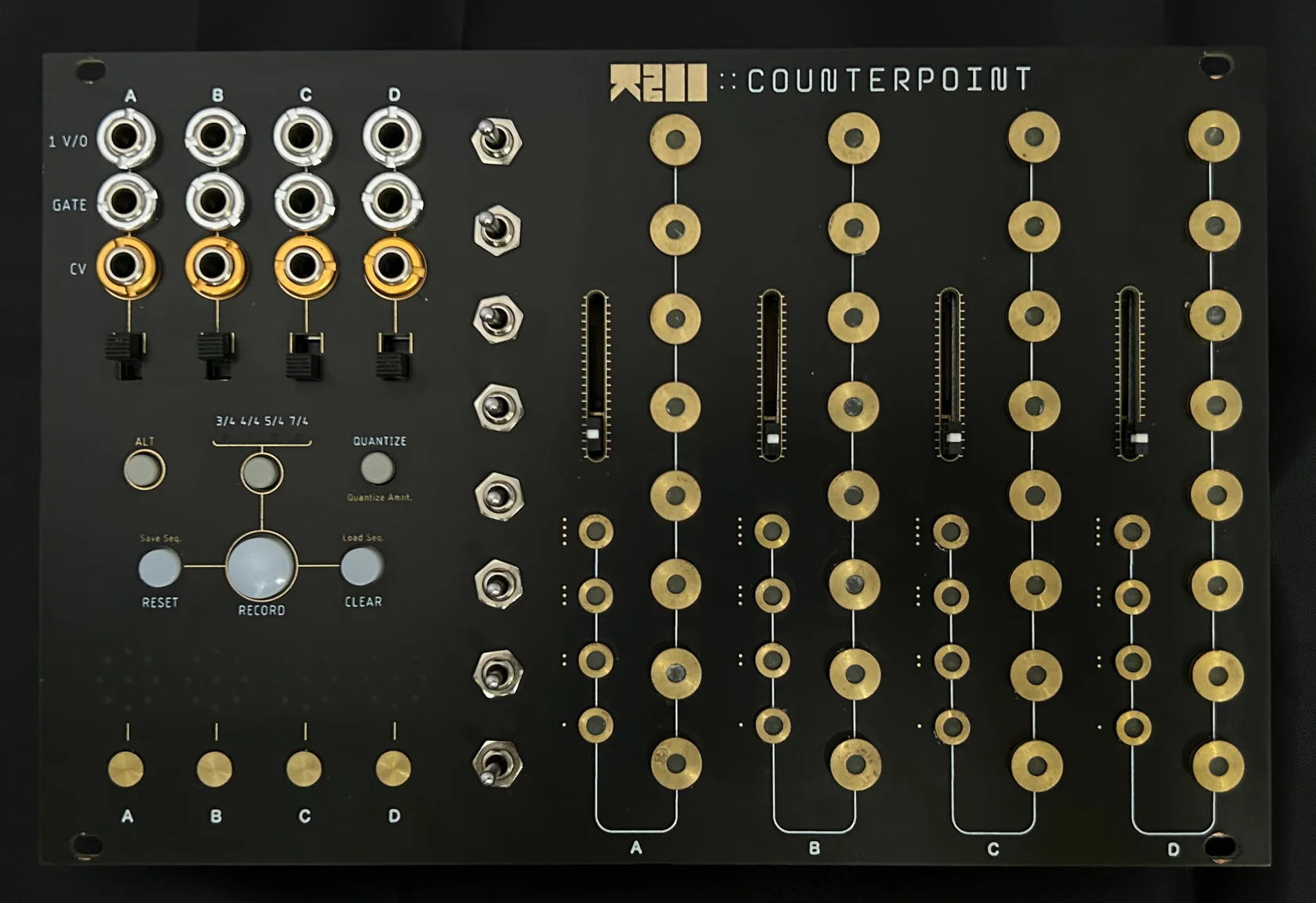
The second iteration of Counterpoint stayed in my system for almost two years, which was a good sign that it was getting close to “done.” This version introduced a bunch of new ideas, including:
CV control over slew
Optional CV control for pitch bends
A built-in arpeggiator
A better UI for sequence length / time signature
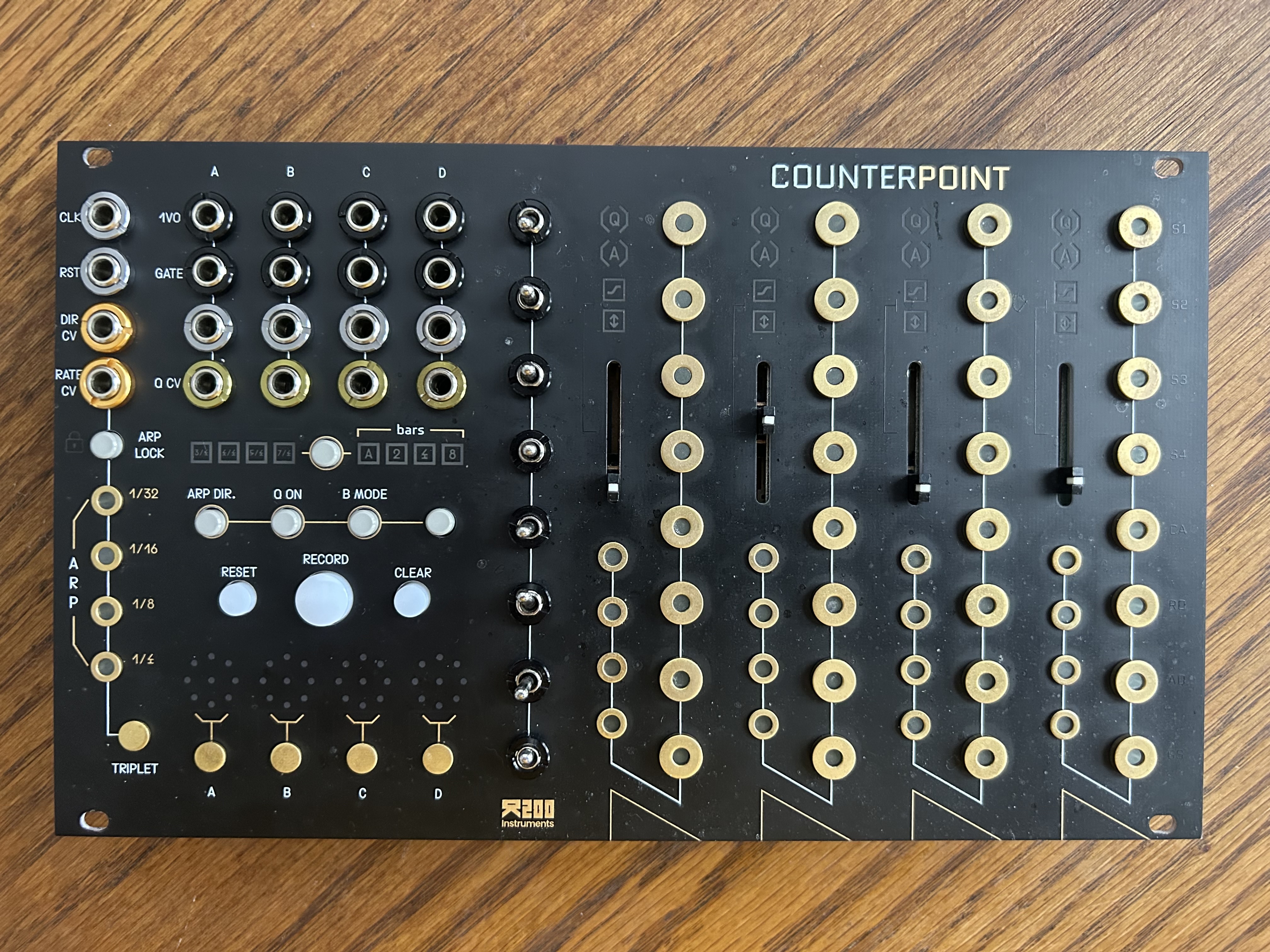
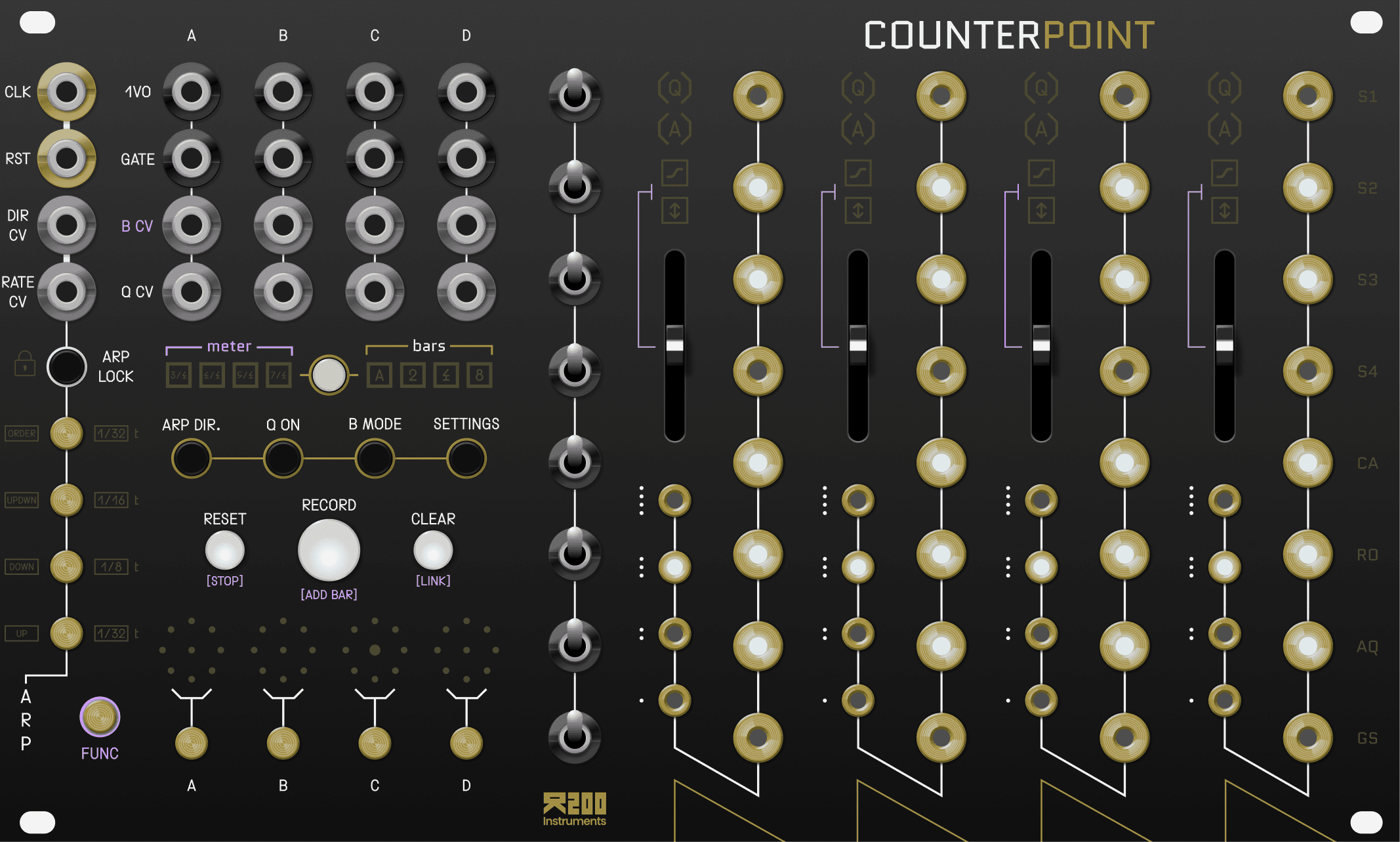
The third iteration is what I’ll be shipping in 2026. The changes here are almost entirely focused on UI improvements. The biggest one is a fully backlit panel for better visibility in dimly lit environments. That feature alone took multiple iterations—there was a lot of trial and error dialing in the right LEDs and matching them with the diffusion properties of the FR4 panel material.
Other UI updates include:
Dedicated LEDs for arpeggiator direction and rate, so you always know the current settings
Backlit indicators on the far right for the “settings” page
Backlit LEDs to represent sequence storage
The DEGREE was (and still is) pretty epic, but the addition of the “Benders” was definitely a case of scope creep. What ended up happening is that I combined what probably should have been two separate modules into one. The core design still holds, but Counterpoint is really my attempt to isolate my original ideas around polyphony and sequencing in a multi-oscillator Eurorack system.
That said, Counterpoint wasn’t immune to scope creep either 😅… just a bit more controlled this time.
One area I really wanted to improve was live sequencing and looping. I spent a lot of time looking at other looper designs—especially guitar pedals—and came to the conclusion that reliability is everything during a performance. The best way to achieve that is with preset loop lengths, as opposed to loops that keep growing until you manually stop recording.
You see the “punch in / punch out” approach all the time: hit record to start, hit it again to stop, and that defines the loop length in real time. The problem is that extra step. When you remove it—by using a fixed loop length—you free up just enough mental bandwidth to focus more on actually playing in a good sequence of notes.
Of course, that approach isn’t always ideal, which is why Counterpoint still includes an “AUTO” sequence length mode for that traditional punch-in/punch-out style of looping.
Arpeggiator
One idea I’m surprised never came up during the development of the DEGREE was using the touch pads as input to an arpeggiator. Maybe I overlooked it because arpeggiators are relatively rare in Eurorack, and are usually patched together using a quantizer plus a sequencer or LFO.
Adding an arpeggiator to Counterpoint was definitely another case of scope creep—but it turned out to be a great addition, especially when paired with sequencing.
Each channel can be configured to arpeggiate over selected scale degrees and octaves at various rates (1/4, 1/4t, 1/8, 1/8t, etc.) and playback modes (up, down, up-down, order). You can think of this as a “static” arpeggiator mode.
You can also use it more like a traditional keyboard arp, where it responds to the currently touched scale degrees in real time. This is where it really shines. When combined with the sequencer/looper, it becomes very easy to generate melodic basslines and leads. This will be easier to demonstrate in a video (coming soon).
Auto VCO Calibration
I’ve also been collaborating with another designer on a polysynth, and one of the first challenges we tackled was designing a digitally controlled analog VCO. It ended up being a really interesting project, and one of the biggest takeaways was a deeper understanding of how to digitally calibrate an analog oscillator to track properly over 1V/oct.
I was able to apply that work directly to Counterpoint and develop a proper VCO calibration routine. It works perfectly 👌. The process takes less than five seconds per channel and gives you accurate tuning across eight octaves for all connected VCOs.